Bee spanking salvia plants - with video!
It’s no secret I’ve become obsessed with botany over the last two months. I’ve been going out since the beginning of spring and taking photos of plants as a way to learn identification. iNaturalist is a great application both for amateurs like me and actual scientists doing research, you take photos and upload them tagging time and place and optionally add an identification.
Lamiaceae, the mint family
I bought Botany in a Day by Thomas J Elpel and I’ve been trying to memorize and recognize the plants I see around me. Elpel’s book is based around learning taxonomic families of plants.
Families are a perfect middle scale category to learn, not too big and not too small. The flowers of plants are usually the best way to identify a family. Even if the habit (size and overall body of the plant) is very different between related species, their flowers will give away their common ancestry. As a consequence I’ve been spending a lot of time zoomed way in on tiny flowers out in the fields and parks by my house.
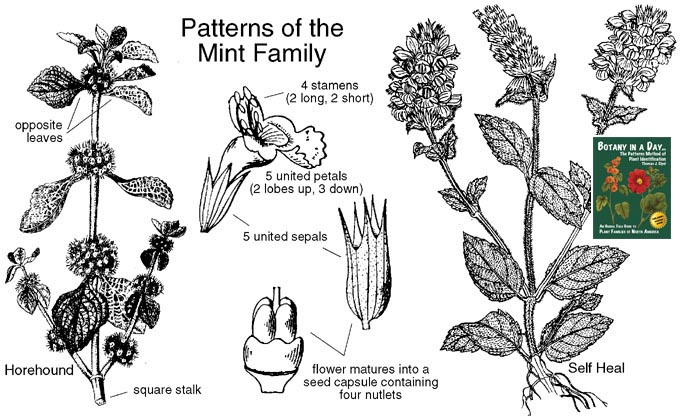
Identification guide for mint family from Botany in a Day by Thomas J Elpel
Plants in the mint family are particularly easy to spot, which is probably why I’ve been focusing on them lately. The mint family includes many human used plants such as sage, rosemary, thyme, oregano, lavender, and obviously the edible mints. Here in this season you can see the bright purple flowers sticking out of tall solitary towers.
Flowers as functions
When identifying a flower you obviously check the number and shape of petals, but also the reproductive organs like stamens (male, pollen producers) and the pistils (female, contains ovary). The arrangement of these features are highly evolved to their particular pollination syndrome, that is the method of pollination the plant focuses on.
Plants visited by birds are shaped like the bird’s beaks (and simultaneously shape those beaks!), moth pollinated flowers may only open at night when their particular moths are around, flowers that stink like rotting meat are trying to attract flies. There is generally an evolutionary reason for every difference.
Here’s a particular mint family plant called Salvia pratensis which I saw along the banks of a canal.
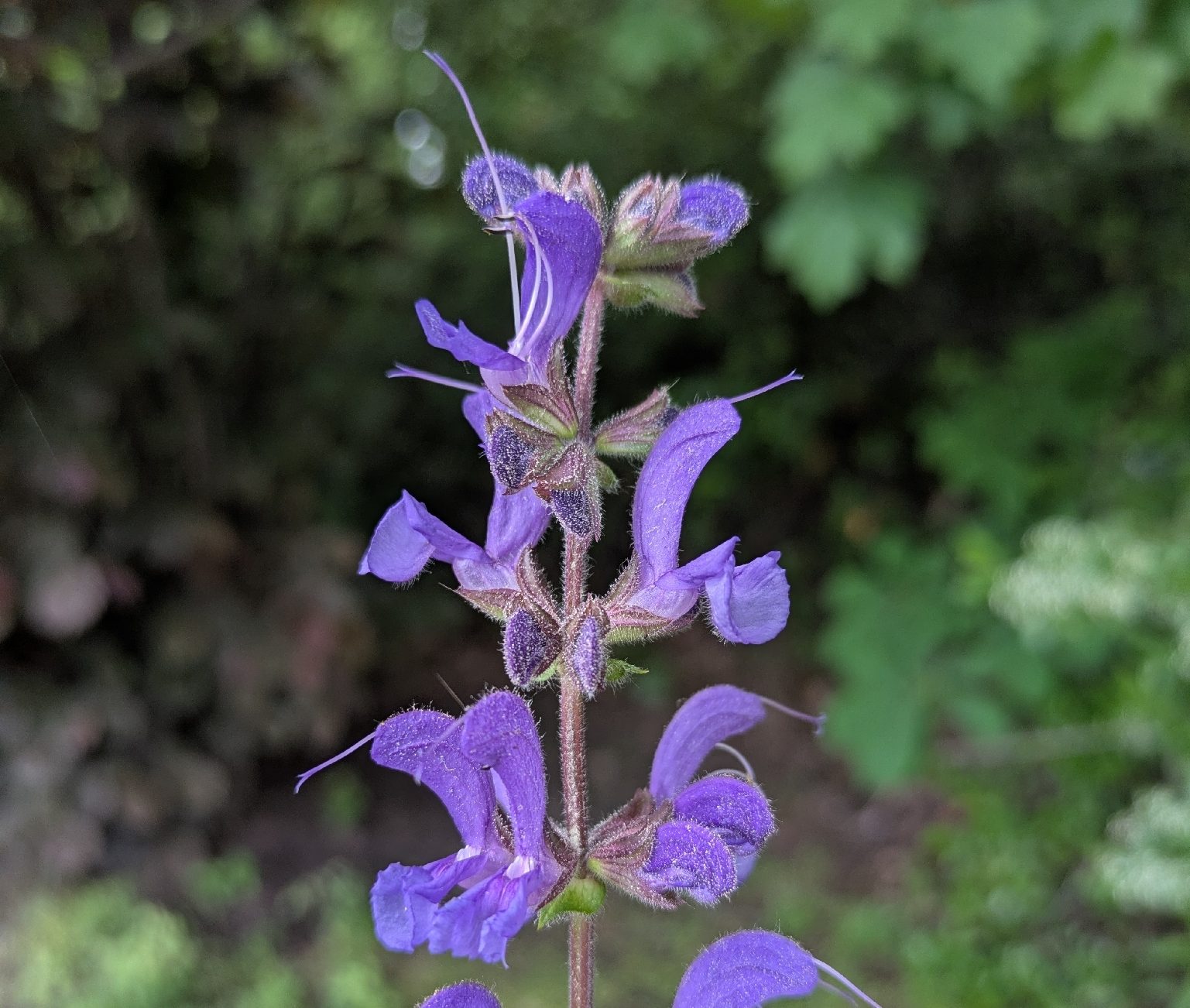
Salvia pratensis aka sage of the meadow
Immediately I noticed the funny long thin threads poking out of the flowers. These are the pistils, the female part of the flower awaiting pollen. But where are the stamens? And why is the pistil poking out from a the top of a envelope of petals rather than typically in the center of the flower?
Some quick searching about this Salvia pratensis species and pollination turned up an answer very quickly.
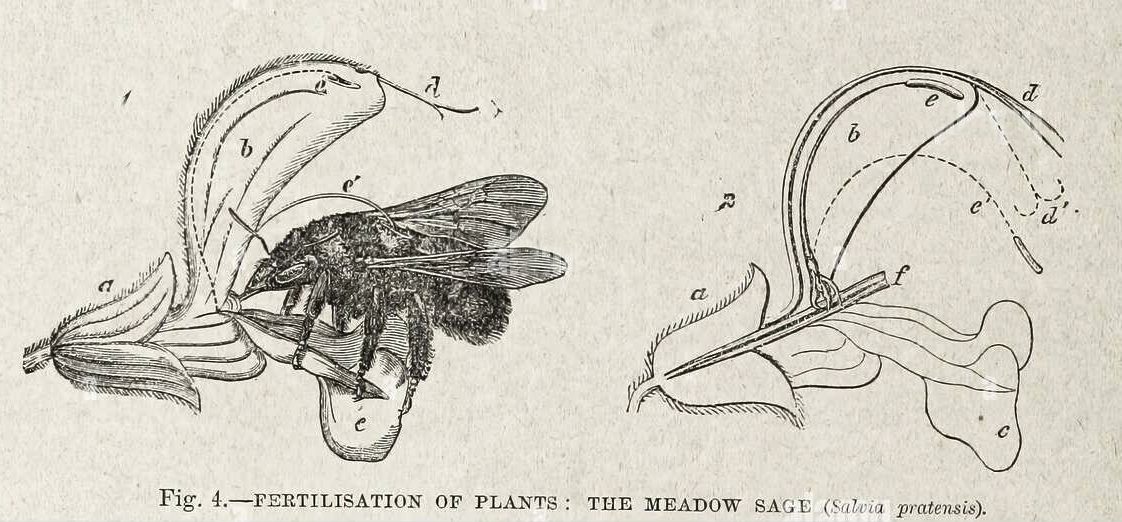
Diagram of bee activating stamen lever mechanism from ‘Our Earth and its Story: a popular treatise on physical geography’
Unlike a simple flower where pollen-loaded stamens are on full display for pollinators, Salvia pratensis hides the stamens inside that upper envelope. There’s a physical mechanism, centered in the middle of the flower, which the pollinator has to push on in order to drink the nectar at the back of the flower. This mechanism is like a lever arm which pops the backwards curving stamens out of the top envelope and onto the back of the insect!
Here’s a video I took of manually activating this stamen lever.
But why?
The theory is that this stops insects that would otherwise take all the pollen. Plants attract pollinators specifically because they will move pollen to other plants of the same species. But for pollinators that eat the pollen like honey bees, they can be too good at collecting it! Rather than taking some of the pollen between plants, species like honey bees carefully collect all the grains and take them home to produce honey. The stamens of Salvia pratensis are curved at the right angle to ‘spank’ the pollinators on the back of the abdomen, dusting them with pollen in a hard to reach place. When that same bee flies to another flower it will wipe some of that pollen off on the dangling pistil, completing pollination for the pair of plants.
Obviously I didn’t do any original research in this area, but what excited me so much was that I managed to trace the same path that the real scientists had gone down. I started making observations of plants and flowers in general, noticed something specialized in a particular species, and guessed it would have a specific function. How cool that it turned out to be something I could go physically test myself!